
Most Southeast commercial energy code questions come down to two documents: ASHRAE 90.1 and the commercial provisions of the IECC. Your project follows whichever one your state has adopted, and in many cases you can comply through either path. When contractors and owners ask when commercial air leakage testing is required, the answer usually ties back to one of these standards. Commercial IECC-compliant projects in the Southeast may require a tested air barrier based on the adopted code edition, while ASHRAE 90.1 air leakage testing requirements apply whenever your team follows that compliance path.
In this blog, we’ll break down how the two codes differ, how South Carolina, North Carolina, and Georgia adopt and enforce them, and when a whole-building air leakage test becomes part of your scope.

Both standards set minimum energy requirements for commercial buildings. They overlap heavily, but they take different approaches.
Here’s the practical part. When your spec allows either, your design team picks the path that best fits the building. Both routes can require air-barrier continuity and, on many projects, a measured leakage test to prove the envelope performs as designed.
Adoption is a state decision, and enforcement happens at the local level through the authority having jurisdiction (AHJ). That local layer matters. Two projects under the same state code can face different documentation demands depending on the county or city reviewing them.
South Carolina is one of three states where understanding the commercial energy code starts at the state level, along with NC and GA. South Carolina adopts statewide energy provisions through its building code council, with the IECC commercial chapter as the backbone. Local AHJs in the Midlands and Upstate handle plan review and final inspection. Government and civic work around Columbia often carries added scrutiny, so confirm submission format early. For project-level help, see our Commercial Air Leakage Testing in Columbia, SC page and our South Carolina commissioning testing partner page.
North Carolina runs its own energy code, built on the IECC framework and adopted and updated by the state. The Charlotte metro drives heavy commercial and mixed-use volume, and Mecklenburg-area reviewers know envelope testing well. Our Commercial Air Leakage Testing in Charlotte page directly covers that market.
Georgia amends the IECC through its Department of Community Affairs and enforces it at the local level. Documentation expectations vary between metro Atlanta and Northeast Georgia jurisdictions, so verify what your reviewer wants before closeout. Our Georgia multifamily energy code compliance page speaks to developer-side work in the state.
A whole-building air leakage test is not automatic on every job. It gets pulled into scope by one or more of these:
If any of these apply, plan for the test before drywall hides the barrier. Early verification catches problems before fixes become expensive.
Don’t guess. Lock down the answer with a few direct steps.
Nail those down at the start, and the closeout stops being a surprise. For a technical look at the standards behind the numbers, our blog comparing ASTM E779 and E1827 delves into the test methods themselves.
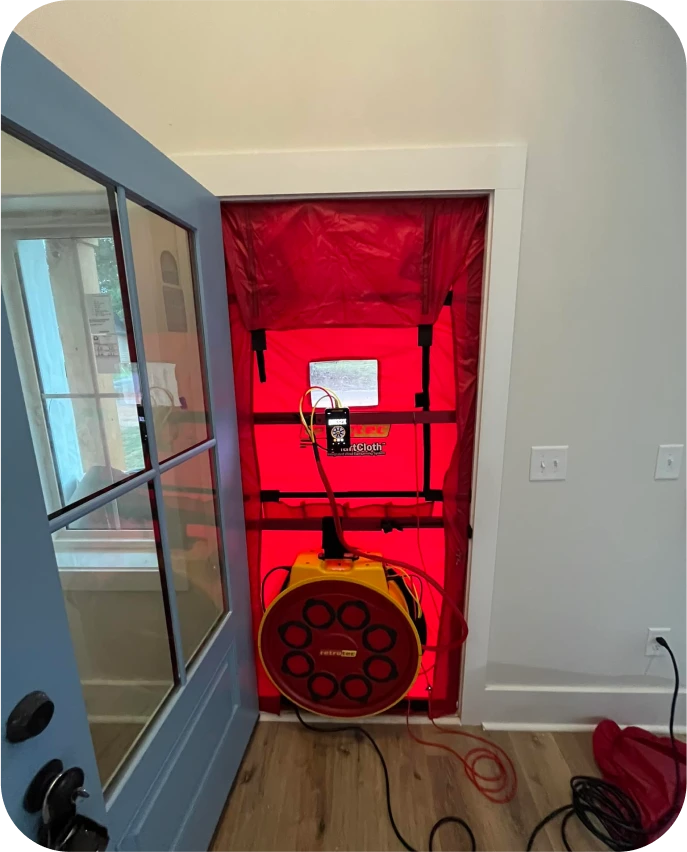
The safest move on any Southeast commercial energy code project is to identify your governing path and testing triggers during design, not during final inspection. That gives your team room to build the barrier right and prove it.
Reach out now, and the Air Tight Solutions team will walk you through the requirements so you can move forward with confidence.
In most cases, we can get your test on the calendar for the very next day. The building needs active power and fully installed mechanical systems before we arrive.
Every quote covers the test itself and all required documentation. We deliver complete paperwork so your team can submit it directly to the county for final inspections.
No. We discuss all costs openly before any work begins, and our quotes are all-inclusive. If you want a detailed breakdown for your specific project, reach out, and we’ll walk through it with you.
We don’t handle permits, but the documentation we provide can be submitted directly to the county for final inspections, so your approval process stays clean and straightforward.
Pricing depends on the size of the building, the scope of testing required, and the complexity of the project. Contact Air Tight Solutions for a free consultation and a customized quote tailored to your specific situation.